
Your child’s front teeth are starting to overlap, or their bite looks slightly off when they smile. You have heard that Invisalign works for children now, not just adults, but you are not sure whether your child is old enough, or whether it is better to wait.
It is one of the most common questions parents ask us, and the answer depends less on your child’s age than you might expect.
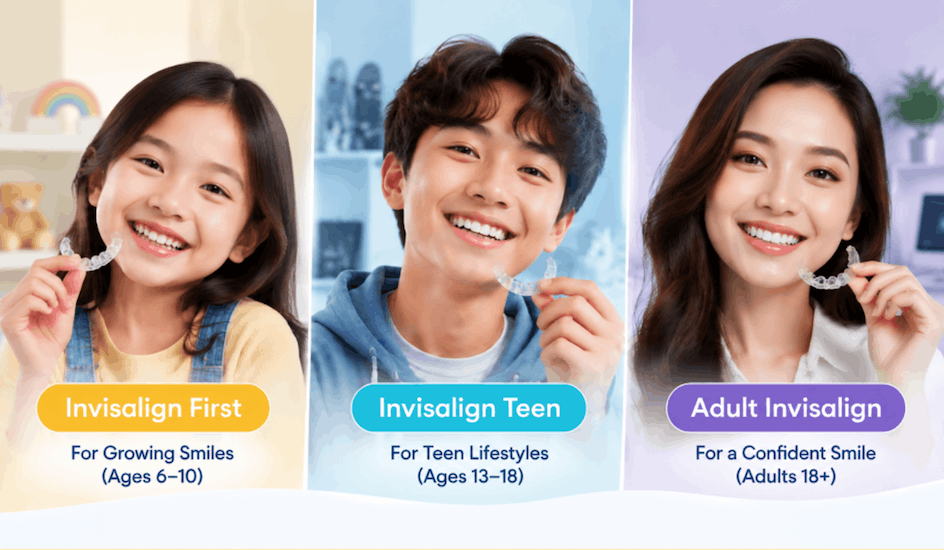
In short: Invisalign First is designed for children aged 6 to 10 who still have a mix of baby and adult teeth. Invisalign Teen is for roughly ages 13 to 18, once most adult teeth have come through. Adult Invisalign has no upper age limit. The right system depends on which teeth your child currently has, not simply how old they are.
This guide covers the differences between the three, what the blue compliance indicator actually does, what treatment costs in Malaysia, and how we decide which system fits your child.
Quick Comparison: Invisalign First, Teen and Adult
| Feature | Invisalign First | Invisalign Teen | Adult Invisalign |
|---|---|---|---|
| Typical age | 6 to 10 | 13 to 18 | 18+, no upper limit |
| Teeth stage | Mixed baby and adult | Most adult teeth through | All adult teeth |
| Treatment phase | Phase 1 | Phase 2 | Single course |
| Compliance indicator | Optional | Yes, blue dots | No |
| Allows for erupting teeth | Yes, eruption compensation | Yes, eruption tabs | Not needed |
| Free replacement aligners | No | Up to 6 | No |
| Main goal | Guide jaw and arch growth | Straighten adult teeth | Straighten adult teeth |
| Price at Dental Home | RM9,500 to RM19,000 |
Phase 1 and Phase 2: Why Treatment May Happen Twice
Orthodontic treatment for children often happens in two separate stages, several years apart. They are called Phase 1 and Phase 2.
Phase 1
Phase 1 happens between roughly ages 6 and 10, while your child still has a mix of baby and adult teeth. The goal is not to straighten every tooth. It is to guide how the jaw and dental arches develop, so there is enough room for the adult teeth still to come. Align Technology describes this as developing the jaws and arches to make room for existing and incoming permanent teeth.
A monitoring period follows. Your child wears a retainer while the remaining adult teeth erupt naturally. This stage can last a couple of years and involves regular check-ups rather than active treatment.
Phase 2
Phase 2 happens in the teenage years, once all or most adult teeth are present. This is the stage that straightens and aligns those adult teeth into their final positions.
Here is the honest part. Two phases mean two courses of treatment, and two separate costs. Some clinics avoid mentioning this upfront. We would rather you know at the start, because it changes how you plan.
It is also worth saying that not every child needs both phases. Some children complete Phase 1, their adult teeth come through well, and no further treatment is needed. Others go straight to Phase 2 as teenagers without any early treatment at all. Which path your child takes depends on what we see during their assessment.
Invisalign First: Ages 6 to 10
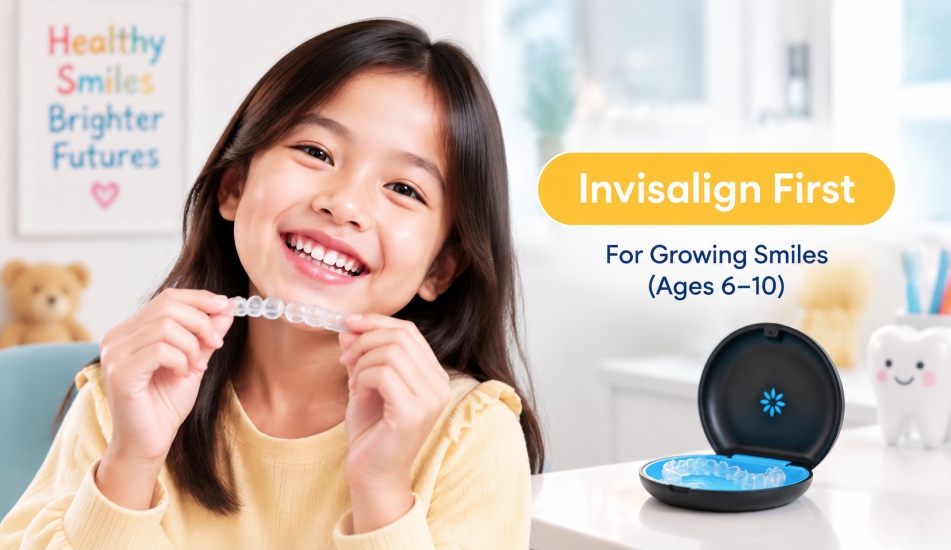
Invisalign First is designed for children in what dentists call mixed dentition, meaning they still have some baby teeth alongside their first adult teeth.
According to Invisalign Malaysia, the system is built to treat a broad range of issues in growing children, including crowding, spacing and narrow dental arches.
What Invisalign First can treat
- Crowded teeth, where there is not enough room for teeth to sit properly
- Gaps and spacing between teeth
- Narrow dental arches, where the upper or lower jaw is too narrow
- Guiding incoming adult teeth into better positions
- Preserving space so adult teeth have room to come through
Is your child clinically suitable?
Age alone does not determine suitability. There are specific clinical requirements your child needs to meet:
- The first permanent molars must have already erupted, which usually happens around age 6
- Baby teeth must still be present in all four quadrants of the mouth
- There should be no more than two consecutive missing teeth
If your child has only baby teeth, they are too young. If they have already lost most of their baby teeth, Invisalign First is no longer the right system, and we would look at Teen or adult options instead.
Why parents often prefer it over fixed braces at this age
The aligners are removable, which matters more for a six-year-old than it might sound. Brushing and flossing stay completely normal, with no brackets or wires to work around. There are no food restrictions. For a child still learning good oral hygiene habits, not making brushing harder is a real advantage.
The Invisalign Palatal Expander
For children who need a wider upper jaw, the Invisalign Palatal Expander can be used alongside Invisalign First. It is available at Dental Home.
It is a newer alternative to the traditional fixed expander many parents remember from childhood, when a screw in the roof of the mouth had to be turned by hand every day. The Invisalign version is a 3D printed device that works through a series of expanders instead.
Signs Your Child May Need an Early Assessment
You do not need to diagnose anything yourself. But there are signs worth mentioning to your dentist:
- Crowded or overlapping front teeth around age 7 or 8
- Baby teeth lost much earlier or much later than expected
- Difficulty chewing or biting food
- Breathing through the mouth rather than the nose
- A thumb sucking habit that has continued past the toddler years
- Front teeth that protrude noticeably
- Teeth that do not meet properly when your child bites down
- Speech difficulties that do not seem to be improving
The American Association of Orthodontists recommends a first orthodontic check-up by age seven. By that point, enough adult teeth have come through to spot developing problems, while there is still plenty of growth left to work with.
An early assessment does not mean early treatment. Often the outcome is simply to monitor and reassess in a year. You can read more about children’s dental care at Dental Home and what a first visit involves.
If the concern is specifically an overbite, where the lower jaw sits further back than the upper jaw, there is a separate treatment designed for that. Invisalign mandibular advancement guides the lower jaw forward while straightening the teeth at the same time.
Invisalign Teen: Roughly 13 to 18
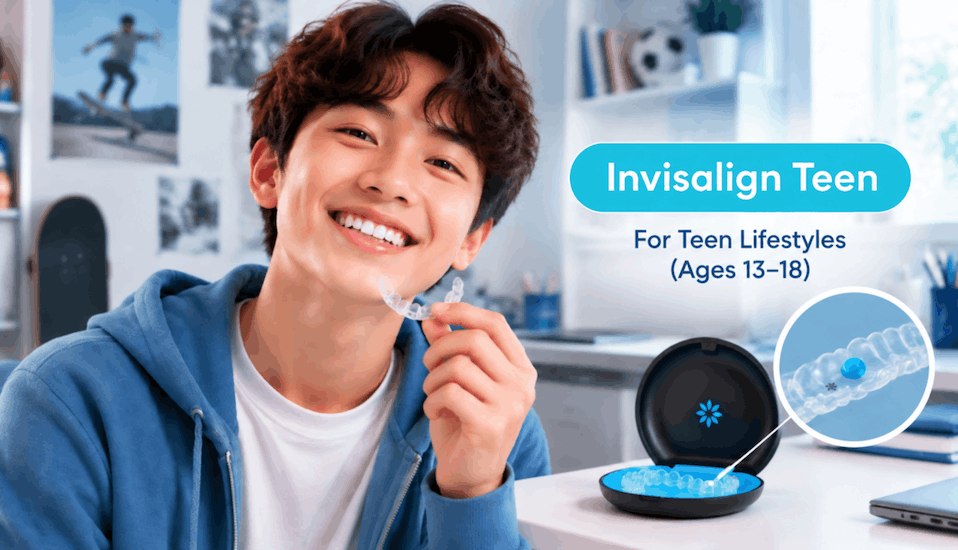
Invisalign Teen is designed for when most adult teeth are in place, typically around age 13, though this varies from child to child. Some children are ready earlier — around 11 or 12 — if most of their adult teeth have already come through. Others aren’t ready until 13 or later. It comes down to what we see at assessment, not their birthday. It treats the same range of issues as adult Invisalign, but with three features built specifically for teenagers.
Eruption tabs
Second molars often have not come through yet at this age. Eruption tabs hold space in the aligner for those teeth to erupt naturally during treatment, so the aligners do not need remaking as your child grows.
Free replacement aligners
Invisalign Teen includes up to six replacement aligners at no extra charge. This exists because teenagers lose things, and a tray left in a school canteen should not derail a treatment plan or trigger an unexpected bill.
The blue compliance indicator, explained for parents
This is the feature parents ask about most, so it is worth explaining properly.
Each Invisalign Teen aligner has small blue dots on the rear section, near the molars. They are not visible when the aligner is being worn, so your teenager does not need to feel self-conscious about them.
The dots are made from a medical grade, non-toxic dye that reacts to saliva. When the aligner is worn as instructed, for 20 to 22 hours a day, the dye gradually fades from blue to clear over roughly two weeks. Invisalign Malaysia describes them as an optional feature that helps parents monitor progress and keep children motivated.
If the dots are still clearly blue when your teenager comes in for a review appointment, it tells us they haven’t worn them as long as they should.
A note on how to use this. In our experience, the compliance indicator works best to remove arguments at home, not to catch teenagers out. Instead of asking whether they have been wearing their aligners and getting a vague answer, everyone can simply look at the dots. It turns a source of friction into a shared fact.
Most teenagers who are genuinely motivated about their smile wear their aligners. The indicator catches those who are drifting early enough that it doesn’t extend treatment.
Adult Invisalign: No Upper Age Limit
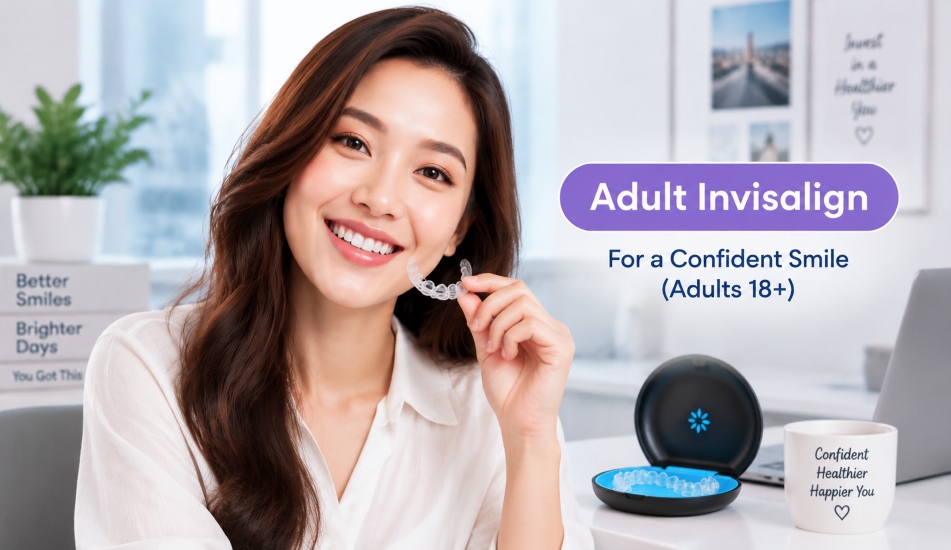
There is no age at which it becomes too late to straighten your teeth. As long as your teeth and gums are healthy, treatment is possible.
Adults come to us for different reasons than children do.
-
Career and confidence. Many adults work in client-facing roles where visible fixed braces feel like a barrier. Clear aligners solve that.
-
A fixed date. Weddings, milestone birthdays, family photographs. Adults often arrive with a specific deadline, which shapes which treatment tier makes sense.
-
Relapse after childhood braces. This is more common than people expect. Someone had braces as a teenager, stopped wearing their retainer after a few months, and their teeth gradually shifted back over the following years. If that sounds familiar, what retainers do after treatment explains why it happens.
Adult treatment comes in different tiers depending on how much correction is needed, from shorter treatments for minor adjustments to comprehensive plans for more complex cases. Your dentist will explain which fits your case at consultation.
How Dental Home Decides Which System Fits Your Child
The decision is driven by your child’s dental development, not their birthday. Two children of the same age can need completely different approaches.
-
A digital scan: We take an iTero digital scan of your child’s teeth. No impression trays and no mess, which makes a considerable difference with younger children.
-
A review of which teeth are present: We look at which adult teeth have come through, which are still to come, and how much space there is for them.
-
An assessment of jaw growth: How the upper and lower jaws are developing, and whether a bite issue would benefit from early intervention.
-
A treatment plan you can see: Using ClinCheck software, we map out the proposed tooth movements and show you the projected outcome before treatment begins. You will see what we are aiming for, not just be told about it.
From that, we recommend one of three things: start Phase 1 treatment now, monitor and reassess in six to twelve months, or wait until more adult teeth are through and treat in a single phase later.
Invisalign Cost for Children and Teens in Malaysia
Invisalign treatment in Malaysia generally ranges from around RM8,000 to RM25,000, depending on case complexity and treatment length.
At Dental Home, treatment across the three systems ranges from RM9,500 to RM19,000. Where your child falls within that range depends on which system suits them, how much movement is needed, and how long treatment runs.
If your child needs both Phase 1 and Phase 2, these are two separate courses of treatment with two separate costs. Your dentist will explain what applies to your child’s case before you commit to anything, and you will receive a written quote after the consultation.
Talk to Us About Your Child’s Options
If your child’s teeth look crowded, their bite seems off, or you’re not sure whether it is time to do something, an assessment will show you where things stand. Often the answer is to wait and monitor, which is useful to know either way.
Book an assessment with the Dental Home team at any of our five clinics in Puchong, Bukit Jalil and Mont Kiara. We will scan your child’s teeth, explain what we see, and give you a straight answer about whether treatment makes sense now or later.
Frequently Asked Questions
Can my 8-year-old get Invisalign?
Possibly. Invisalign First is designed for children aged 6 to 10, so your child is within the age range. What matters more is whether they meet the clinical requirements, which include having their first permanent molars through and baby teeth still present in all four quadrants. An assessment will confirm this.
Is my child too young for braces?
Age alone rarely rules a child out. A first orthodontic check-up is commonly recommended around age seven, and early treatment is often more about guiding jaw growth than straightening teeth. If your child is too young to benefit from treatment now, the outcome of an assessment is simply to monitor and review later.
What is the difference between Invisalign First and Invisalign Teen?
Invisalign First is for children aged 6 to 10 who still have baby teeth, and focuses on guiding jaw and arch development. Invisalign Teen is for roughly ages 13 to 18, once most adult teeth are through, and focuses on straightening those adult teeth. Invisalign Teen also includes blue compliance indicators and up to six free replacement aligners. Invisalign First can include a compliance indicator too, but it’s optional rather than automatic, and it doesn’t come with the free replacement aligners.
Will my child need treatment twice?
Some children do, and some do not. Phase 1 treatment in childhood can be followed by Phase 2 in the teenage years, but not every child needs both. Some complete Phase 1 and need nothing further. Others skip early treatment entirely and are treated once as teenagers. Your dentist will give you a realistic view at assessment.
How do I know if my teenager is actually wearing their aligners?
Invisalign Teen aligners include blue compliance indicator dots that fade from blue to clear when worn 20 to 22 hours a day over about two weeks. If the dots are still blue at a review appointment, wear time has been insufficient. It is a straightforward way for parents and dentists to check without relying on guesswork.
What happens if my teenager loses an aligner?
Invisalign Teen includes up to six free replacement aligners, which covers most situations. Contact us as soon as you notice one is missing, since going without an aligner for an extended period can affect the treatment timeline.
Is Invisalign as effective as braces for children?
For many cases, yes. Clear aligners can treat a broad range of issues including crowding, spacing and narrow arches. Some complex jaw problems are still better treated with fixed braces, and your dentist will tell you honestly if that applies to your child rather than recommending aligners regardless.
How much does Invisalign cost for a child in Malaysia?
Invisalign in Malaysia generally ranges from around RM8,000 to RM25,000 depending on complexity and treatment length. At Dental Home, treatment across Invisalign First, Teen and adult Invisalign ranges from RM9,500 to RM19,000. If your child needs both Phase 1 and Phase 2, these are charged as two separate courses of treatment.
At what age should my child first see an orthodontist?
The American Association of Orthodontists recommends a first orthodontic check-up by age seven. By that stage enough adult teeth have come through to identify developing problems, while there is still plenty of jaw growth remaining to work with. At Dental Home, one of our Invisalign-certified dentists would see your child.
Can my child play sports and musical instruments with Invisalign?
Yes. You can remove aligners for contact sports and wear a mouthguard instead. For wind instruments, most players adjust quickly, and being able to remove the aligners for a performance is an advantage fixed braces don’t offer.
About the Author
Dr Shaun Tan Pei Shian, BDS (IMU), MDC 7669
Dr Shaun is the founder and lead Invisalign provider at Dental Home, with 12 years of experience in clear aligner treatment. He provides personalised Invisalign treatment planning for patients with orthodontic concerns, including bite alignment and overbite correction.