
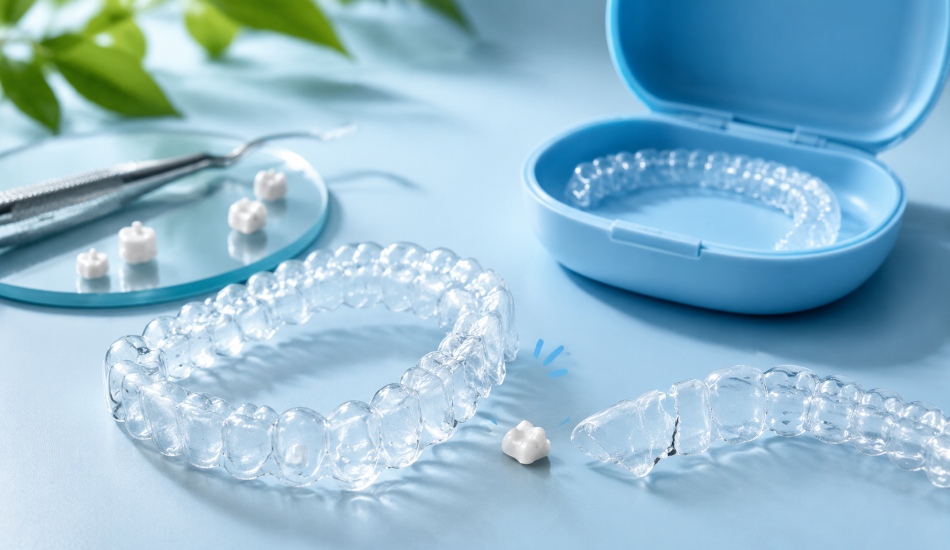
It’s a common moment in Invisalign treatment: you feel something unusual in your mouth, check, and realise that one of the small, tooth-coloured bumps on your tooth, called a SmartForce attachment, has come loose or disappeared. Or you take out your aligner and notice a hairline crack across the tray. Before you worry, know this: attachment loss and minor aligner damage are among the most common issues Invisalign patients encounter, and in most cases, treatment continues safely while you arrange to see your dentist.
In short: if a single attachment falls off and your aligner still fits normally, keep wearing it as usual and contact Dental Home to schedule a re-bonding appointment; it is not an emergency. If your aligner no longer seats properly on that tooth, revert to your previous tray and call us. The same logic applies to a cracked tray: minor and stable means carry on; poor fit or sharp edges means act faster.
According to general orthodontic care principles, oral health guidance, dental appliances such as braces and aligners require routine maintenance, and minor issues like debonded attachments or damaged appliances can usually be managed without interrupting treatment — always confirm with your treating dentist.
What to Do If Your Invisalign Attachment Falls Off
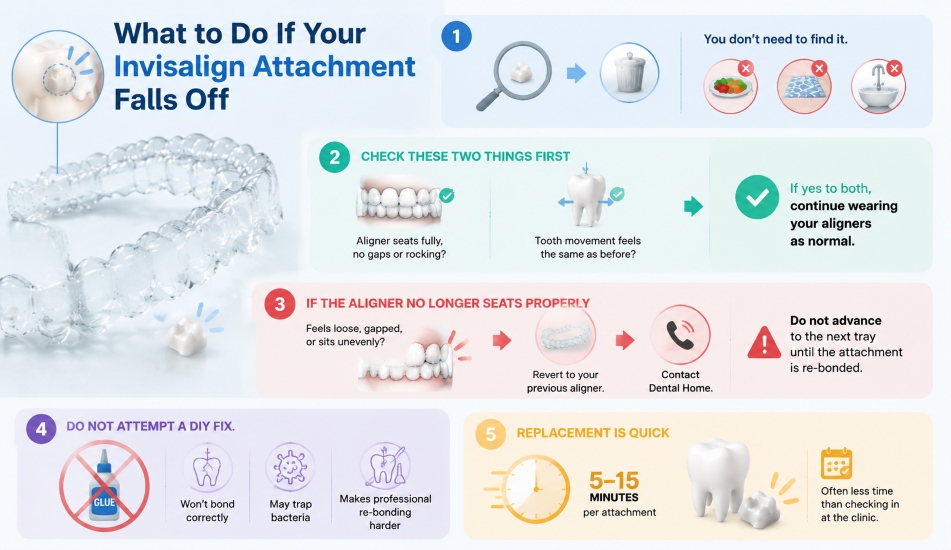
First: you don’t need to find it. There is no need to search your meal, the floor, or your sink; the detached attachment cannot be reused, and your dentist will bond a brand-new one from scratch at your next visit.
Check these two things first:
- Does your aligner still seat fully and evenly on that tooth, without any gaps or rocking?
- Does the tooth movement feel roughly the same as before?
If the answer to both is yes, continue wearing your aligners as normal. According to Align Technology, if a SmartForce attachment falls off, simply contact your dentist, who will schedule a time to replace it. The missing attachment generally does not affect the teeth on either side of it; each attachment targets only its own specific tooth.
If the aligner no longer sits properly on the tooth that lost its attachment, meaning it feels loose, gapped, or sits unevenly, revert to your previous aligner set and contact Dental Home. Do not advance to the next tray until the attachment has been re-bonded. Without it, the tooth could shift out of position, or its movement could be delayed, since the attachment acts as an anchor for the aligner to apply targeted pressure against that tooth.
Do not attempt a DIY fix. Superglue, household adhesive, or any home-applied product will not bond correctly to enamel, may trap bacteria against the tooth surface, and can make professional re-bonding significantly harder. Only dental offices have the right materials and equipment for reliable attachment bonding.
Replacement is quick. The re-bonding appointment typically takes around 5 to 15 minutes per attachment, often less time than checking in at the clinic.
What to Do If Your Aligner Cracks or Breaks
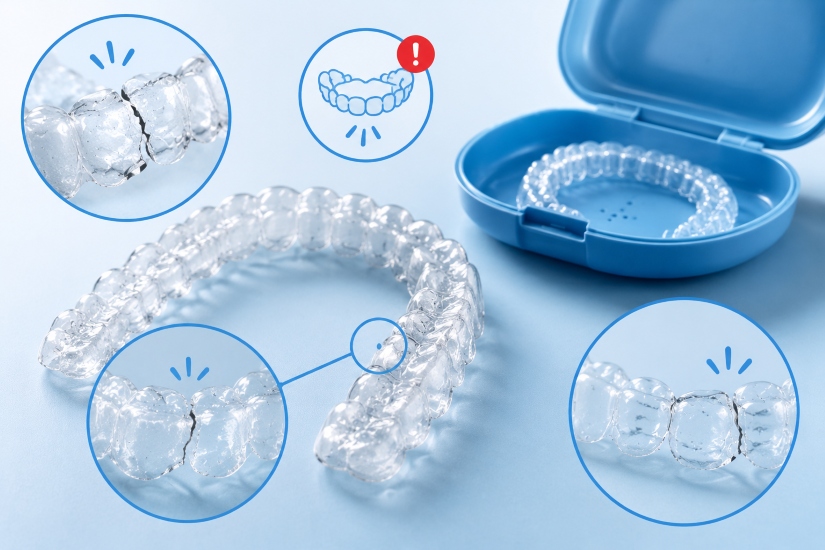
Not all cracks are equal. A hairline surface crack that doesn’t affect the fit or shape of the tray is generally safe to continue wearing for the short term while you contact the clinic. A full split, a break that creates a sharp edge, or any damage that causes the tray to lose its shape requires faster action.
For minor cracks:
- Continue wearing the tray if it seats properly and is not sharp against your gum or cheek
- Avoid hot drinks while wearing it; heat causes the aligner material to warp, which will affect fit and tooth movement
- Do not attempt to reshape or smooth the crack using warm water or a hair dryer, for the same reason
- Contact Dental Home to assess whether a replacement is needed before you move to your next tray
For significant breaks:
- Stop wearing the damaged tray if it no longer holds its shape or has a sharp edge
- Switch back to your previous aligner set temporarily
- Contact Dental Home promptly; continuing with a poorly fitting tray risks teeth moving in an unplanned direction
Warning signs that mean act now: the tray no longer fits snugly, pain or bite pressure increases, or the break creates a rough edge that digs into gum tissue.
What to Do If You Lose Your Aligner
Step 1: Find your most recent previous set. Most patients keep their last worn tray. If you have it and it still fits, your dentist may advise you to wear it while a replacement is arranged.
Step 2: Contact Dental Home immediately. Do not skip to the next tray on your own. Advancing without your dentist’s guidance can allow teeth to shift in an unplanned direction, which may require additional refinement stages to correct later.
Step 3: Your dentist will advise whether to go back to a set, hold the position with your previous tray, or order a replacement, depending on where you are in your treatment plan and how much time has passed. Handled promptly, most replacement scenarios have limited impact on your treatment timeline.
Why Invisalign Attachments Come Loose
It does not always come down to patient habits; sometimes attachment loss is simply part of the normal wear cycle over months of treatment. A 2023 peer-reviewed study published in BMC Oral Health, conducted across Ministry of Health Malaysia orthodontic clinics, confirmed that patient compliance with appliance maintenance instructions is one of the most significant factors in treatment success but equally noted that not all appliance issues are within the patient’s control.
Clinical reasons not always within your control:
- Normal bonding wear over a multi-month treatment course
- Attachments sitting particularly snugly under the aligner, creating repeated stress during removal
- Bonding agent that did not fully cure during initial placement
Habits that increase the risk:
- Biting down on food or objects while the tray is in
- Removing aligners by twisting or pulling unevenly from the front rather than starting at the back molars
- Consuming sugary or acidic foods and drinks, which weaken the seal between tooth enamel and the attachment over time
- Plaque buildup around orthodontic attachments can indirectly compromise bond stability. The bacteria within dental plaque metabolise dietary sugars, producing acids that lead to localised enamel demineralisation around the attachment site. This microenvironmental breakdown at the tooth-surface interface can gradually weaken the bond’s underlying structural foundation. Over time, standard masticatory and mechanical forces become sufficient to dislodge the attachment. Ultimately, poor oral hygiene remains a primary driver of deteriorating clinical outcomes in orthodontic therapies, directly increasing the risk of bond and bracket failures.
How to Prevent It From Happening Again
- Remove your aligners correctly: start at the back molars on one side, then the other, and gently peel them forward. Never twist or lever from the front teeth
- Use a removal tool if needed: aligner removal tools (also called PUL tools) are inexpensive and significantly reduce the force placed on attachments during daily removal
- Avoid hard and sticky food: not just while wearing aligners, but immediately after removing them, biting into something hard right after taking out the tray can still stress a freshly loaded attachment bond
- Keep up your oral hygiene: brush gently but thoroughly around each attachment site after every meal to prevent plaque acid from weakening the composite bond
- Attend all scheduled follow-ups: your dentist checks the condition of every attachment at each review and can proactively re-bond any that are worn. Malaysia’s Ministry of Health recommends regular dental attendance to detect and address treatment issues before they escalate
When to Contact Dental Home Immediately vs When It Can Wait
Can wait — monitor at home:
- A single attachment has come off, the aligner still seats fully and evenly, and the tooth feels normal
- A small hairline crack with no sharp edges and no change to how the tray fits
Contact the clinic promptly:
- The aligner no longer fits properly on any tooth, with or without a missing attachment
- Multiple attachments have come off in a short period
- A crack has created a sharp edge or the tray no longer holds its shape
- You notice pain, increased pressure, or a noticeable change in how your bite feels
Don’t Let Invisalign Issues Disrupt Your Smile Journey — Get Expert Support Today
A loose Invisalign attachment, cracked aligner, or lost tray can feel stressful, but most issues can be managed quickly when handled correctly. The key is knowing when you can continue wearing your aligners and when you should seek professional advice from your treating dentist.
At Dental Home, our experienced Invisalign team is here to help you stay on track throughout your treatment journey. Whether you need an attachment re-bonded, an aligner assessed, or guidance on your next step, our dentists can provide the right solution to protect your progress and achieve the smile you are working towards. Contact Dental Home today to book a consultation and keep your Invisalign treatment moving safely and confidently.
Frequently Asked Questions
Can I keep wearing Invisalign if an attachment falls off?
Yes, in most cases. If a single attachment falls off and your aligner still seats fully and evenly on that tooth, continue wearing your aligners on schedule and contact Dental Home to arrange re-bonding. If the tray no longer fits properly on that tooth, revert to your previous aligner set and call us before advancing further.
Will a cracked aligner delay my treatment?
A minor hairline crack that does not affect fit usually won’t delay treatment if addressed quickly. A significant break that distorts the tray’s shape can because a poorly fitting tray cannot move teeth predictably. Contact Dental Home so your dentist can confirm whether a replacement is needed before your next tray change.
Can I superglue a broken aligner?
No. Invisalign attachments are bonded to teeth using dental composite resin and require professional tools and materials for both placement and replacement. Household adhesives are not biocompatible, will not bond correctly to dental enamel, can trap bacteria against the tooth surface, and may make professional repair significantly more difficult. Never attempt home repair; contact your dentist.
What happens if I skip a tray because I lost it?
Advancing to the next tray without your dentist’s approval can allow teeth to shift in an unplanned direction, potentially requiring additional refinement stages to bring them back on track. Always contact Dental Home first; in most cases the solution is simple (reverting to a previous tray while a replacement is ordered), but it needs to be managed by your treating dentist.
How fast can Dental Home replace an aligner?
Re-bonding a fallen attachment typically takes 5 to 15 minutes in the chair and can usually be accommodated at short notice at any of our five clinics. For a lost or damaged tray, your dentist will advise the fastest replacement route at your appointment. Call us, and we will find the earliest available slot.