
Many patients are interested in Invisalign because it offers a clearer and more discreet way to straighten teeth. But once cost enters the conversation, it is normal to pause and wonder whether treatment is financially realistic.
That is where an Invisalign payment plan can make the process easier to manage. Instead of paying the full amount upfront, some patients prefer to spread the cost across several instalments. This can make treatment feel more accessible, especially for those who are ready to start but want more flexibility with budgeting.
At the same time, it is important to understand what the payment plan actually includes. Not every clinic structures Invisalign payments the same way. Some plans may include consultation, scans, aligners, follow-ups, refinements, or retainers, while others may charge certain items separately.
So before you sign up, it helps to know how Invisalign payment plans in Malaysia usually work, what questions to ask, and how to avoid unexpected costs later.
At Dental Home, patients can discuss their Invisalign options during consultation and understand what their treatment journey and payment arrangement may look like before deciding to proceed.
Why Consider an Invisalign Payment Plan?
Invisalign treatment is a long-term dental investment. For many patients, the main concern is not only the total cost but also how and when it needs to be paid.
A payment plan can help by spreading the treatment cost into instalments rather than requiring full payment up front. This makes it easier to plan your finances while still moving forward with treatment.
For example, rather than paying the full Invisalign treatment fee upfront, a clinic may allow patients to pay a down payment first, followed by monthly instalments over the treatment period. The exact structure depends on the clinic, the treatment plan, and the complexity of the case.
The main benefit is easier budgeting. You can plan your treatment payments alongside your other monthly commitments instead of dealing with one large payment at once.
A payment plan may also reduce financial stress. Invisalign treatment time depends on severity, planned tooth movement, and compliance. Some mild to moderate cases can finish in about 6 months, while many patients fall in a 12 to 18 month window. More complex orthodontic treatment plans can take longer. So a structured payment arrangement can make the journey feel more manageable.
Still, patients should not only look at the monthly amount. It is also important to ask about hidden fees, interest charges, late payment terms, commitment period, and what happens if additional aligners or retainers are needed later.
A good payment plan should be clear from the beginning.
Typical Invisalign Payment Structures in Malaysia
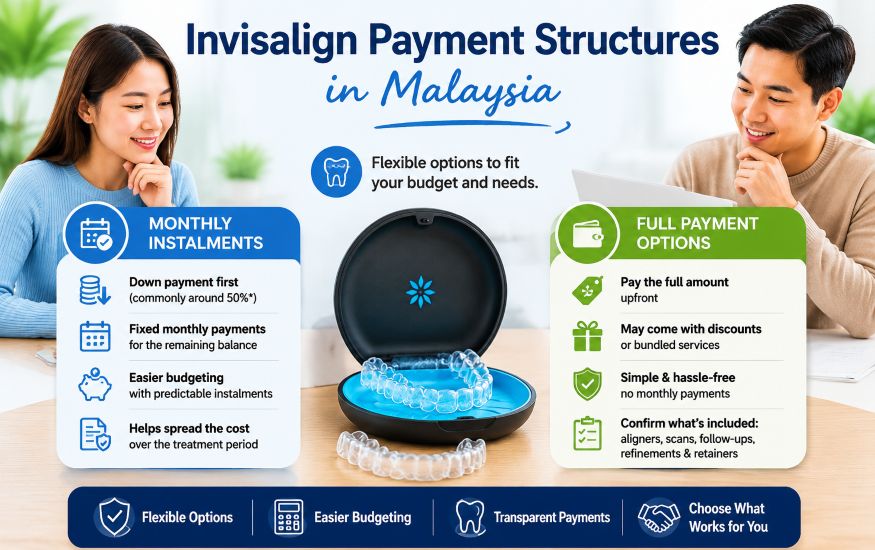
Invisalign payment structures can vary between clinics. Some patients may prefer monthly instalments, while others may choose to pay the full amount upfront.
The right option depends on your budget, treatment complexity, and what the clinic includes in the package.
Monthly Instalments
Many clinics in Malaysia offer monthly payment plans with fixed instalments. This means the total treatment cost is divided into smaller payments across a set period.
However, most clinics still require a significant down payment before treatment begins. In many cases, the down payment may be around 50% of the total treatment cost, though this can vary by clinic.
For example, if the Invisalign treatment cost is around RM20,000, the clinic may require a down payment of around RM10,000, followed by instalments for the remaining balance.
This structure helps clinics cover the initial cost of treatment planning, digital scans, aligner production, and early-stage treatment setup. For patients, the benefit is that the remaining cost becomes more predictable and easier to manage.
Monthly instalments are useful because they give patients a clearer budget. Instead of guessing how much they need to prepare each month, they can plan around a fixed payment schedule.
Before choosing this option, ask how long the instalment period lasts, whether there is any interest, and whether the monthly payment changes if treatment takes longer than expected.
Full Payment Options
Some patients prefer to pay the full cost of Invisalign treatment upfront. This may be suitable if you want to keep administration simple and avoid monthly payments.
In some cases, clinics may offer a discount or bundle services for patients who choose to pay in full. This is not guaranteed, so it should always be confirmed directly with the clinic.
At Dental Home, full Invisalign treatment in Malaysia generally ranges from RM10,000 to RM19,000 for standard cases. More complex bite corrections may cost more, depending on the condition of the teeth and bite, as well as treatment requirements.
The main benefit of full payment is simplicity. Once the payment is made, you do not need to manage monthly instalments. It may also reduce the risk of missed payments or confusion about the payment schedule.
However, before paying in full, always confirm what is included. Ask whether the fee covers all aligners, follow-up appointments, iTero scans, refinements, and retainers. This helps prevent unexpected charges later in the treatment journey.
What’s Included in the Payment Plan?
This is one of the most important questions to ask before starting Invisalign.
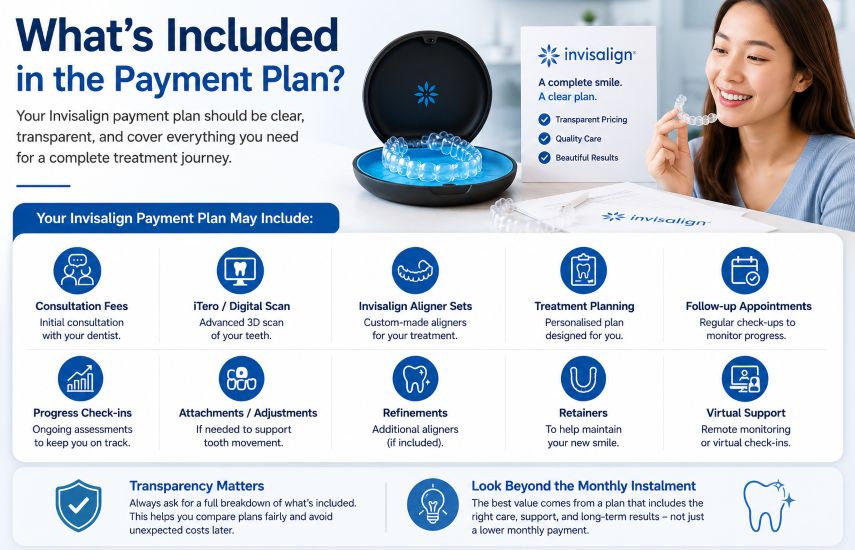
A payment plan should not only show how much you pay each month. It should also explain what the total fee covers. Depending on the clinic, an Invisalign payment plan may include:
- Consultation fees
- iTero scan or digital scan
- Invisalign aligner sets
- Treatment planning
- Follow-up appointments
- Progress check-ins
- Attachments or adjustments, if needed
- Refinements, if included
- Retainers, if included
- Virtual support or remote monitoring, if offered
Some clinics may bundle several items into the total Invisalign package. Others may charge certain items separately. For example, retainers may not always be included in the initial treatment fee. Refinements may also depend on the case and the clinic’s policy.
This is why transparency matters. Patients should understand exactly what they are paying for before treatment starts.
A lower price may look attractive at first, but if important items are excluded, the final cost may be higher than expected. On the other hand, a higher package price may be more worthwhile if it already includes scans, follow-ups, refinements, and retainers.
The best way to compare payment plans is not only by looking at the monthly instalment, but by checking the full treatment value.
Questions to Ask Before Signing Up
Before agreeing to an Invisalign payment plan, it is worth asking a few practical questions. These questions can help you understand the financial commitment clearly and avoid surprises later.
You may want to ask:
- What is the total Invisalign treatment cost? Make sure you know the full amount, not only the monthly instalment.
- How much is the down payment? Ask whether the clinic requires a 50% upfront payment or a different amount.
- How many months can I spread the payment across? This helps you plan your monthly budget.
- Are there any interest charges? Some payment plans may be interest-free, while others may involve financing charges.
- Are there any hidden fees? Ask about the costs of consultations, scans, refinements, replacements, retainers, or follow-ups.
- What happens if I miss a payment? Understand the clinic’s policy before starting treatment.
- Are all follow-up appointments included? Invisalign requires monitoring, so it is important to know whether check-ins are covered.
- Are retainers included after treatment? Retainers are important after orthodontic treatment to help maintain the result.
- Can I pay early without penalty? Some patients may want to settle the balance earlier if their budget allows.
- What happens if my treatment takes longer than expected? Ask whether extra visits, refinements, or aligners may affect the cost.
These questions are not meant to make the process complicated. They help make the decision clearer.
A good clinic should be able to explain the payment terms in an easy-to-understand way.
Financing Options Beyond Clinic Plans
Clinic-based instalment plans are not the only way patients may manage Invisalign payments.
Some patients may choose external financing options, such as third-party financing providers or credit card instalment plans. These options can help spread the cost over a longer period, depending on the provider’s terms.
The difference is that clinic-based instalments are arranged directly with the dental clinic, while external financing is managed through a bank, card provider, or financing company.
Each option has pros and cons.
A clinic-based plan may be more straightforward because it is directly connected to your treatment. However, it may require a higher down payment or shorter instalment period.
A credit card or third-party financing option may offer longer repayment terms, but you should check for interest charges, processing fees, or late payment penalties.
Before choosing external financing, read the terms carefully. The monthly payment may look affordable, but the total cost could be higher if interest or fees are included.
Tips to Maximise Your Invisalign Plan
A good Invisalign payment plan should fit both your treatment needs and your budget.
Here are a few tips before committing:
Ask About Promotions or Bundled Packages
Some clinics may offer seasonal promotions or bundled packages. These may include consultation, digital scans, retainers, or follow-up appointments as part of the overall plan.
Promotions can be helpful, but do not choose based on the discount alone. Make sure the treatment plan still suits your dental needs.
Calculate the Total Cost, Not Just the Monthly Payment
A low monthly instalment may seem attractive, but always calculate the full amount across the treatment period. For example, ask:
- How much is the down payment?
- How many months are the instalments?
- Are there any additional charges?
- Are retainers included?
- Are refinements included?
- Is there interest?
This gives you a clearer picture of the real cost.
Understand What Happens After Treatment
Invisalign does not end the moment your last aligner is completed. After treatment, retainers are usually needed to help maintain your new tooth position.
Ask whether retainers are included in the payment plan or charged separately. This is important because retainers help protect your treatment outcome.
Choose Clarity Over the Cheapest Option
The cheapest plan is not always the best plan. Invisalign treatment depends on proper planning, monitoring, and follow-up.
A clear plan that includes the right support may be more valuable than a lower price with unclear terms.
Common Patient Questions About Invisalign Payment Plans
How much does Invisalign cost in Malaysia?
Invisalign cost in Malaysia can vary depending on the clinic, case complexity, treatment duration, and what is included in the package.
At Dental Home, full Invisalign treatment generally ranges from RM10,000 to RM19,000 for standard cases. More complex bite corrections may cost more.
The best way to know your exact cost is to attend a consultation, where your teeth, bite, and treatment goals can be assessed.
Can I split Invisalign payments over multiple months?
Yes, many clinics in Malaysia offer Invisalign instalment plans. These usually require a down payment first, followed by monthly instalments.
Some clinics may require a down payment of around 50% of the total treatment cost, but this varies by clinic and treatment plan.
What is usually included in an Invisalign payment plan?
An Invisalign payment plan may include the aligners, treatment planning, follow-up visits, and progress checks. Some clinics may also include iTero scans, refinements, retainers, or virtual support.
Always ask for a full breakdown before signing up.
Are there hidden fees?
There should not be hidden fees if the clinic clearly explains the payment plan. However, some items may be charged separately depending on the clinic.
Ask about consultation fees, scans, refinements, replacement aligners, retainers, and follow-up visits.
Is paying upfront better than monthly instalments?
It depends on your budget. Paying upfront may be simpler and may sometimes come with discounts or bundled services. Monthly instalments may be easier to budget for because the cost is spread over time.
The better option is the one that fits your financial situation and gives you clear treatment coverage.
What This Means for Your Invisalign Journey
Invisalign treatment is not only a dental decision. It is also a financial commitment, so it makes sense to understand the payment structure before starting.
A clear payment plan can reduce stress because you know what to expect. You can plan your treatment timeline, monthly budget, and follow-up responsibilities with more confidence.
The most important thing is transparency. Before starting Invisalign, make sure you know the total cost, down payment, instalment amount, treatment inclusions, possible extra fees, and what happens after treatment.
When the financial side is clear, it becomes easier to focus on the treatment itself.
Book a Consultation with Dental Home
If you are considering Invisalign, the best next step is to get a proper consultation. This allows your provider to assess your teeth, bite, and treatment goals before discussing the most suitable treatment and payment options.
At Dental Home, we can help you understand what your Invisalign journey might look like in Malaysia and what payment arrangement may suit your budget.
Find out what your Invisalign journey might look like in Malaysia and choose a plan that suits your budget.